
Online running form analysis
Run better with less injury risk

Break free from bad form: Most runners spend their training time practicing bad form. This makes them run slower and more likely to get injured.
Individual insights, targeted improvements: Movaia’s online running form analysis provides personalized insights into your unique form. Upload your video, we will pinpoint improvement areas and recommend targeted running technique exercises so you will become a stronger runner.
Our comprehensive analysis of your running technique includes marked-up photos that capture critical moments of your gait cycle, providing invaluable insights. But that’s just the beginning!
Clear Descriptions, Actionable Guidance: Our detailed metrics come to life through clear, jargon-free descriptions. Understand every aspect of your form, from foot strike to posture. Plus, receive guidance on how to enhance your performance.
Exercise Videos Tailored to You: Address improvement opportunities head-on! Our reports include easy to follow exercise videos for your identified improvement areas.
Metrics Galore: Scroll down for an in-depth overview of the metrics featured in our reports. From left-right imbalances to rear-view assessments, our Pro-reports leave no stone unturned. And if you’re curious, you can even download a sample report to see it in action.
Pro vs. Free Reports: Pro-reports dive deep, analyzing both sides of your body. Imbalances beware! Add an optional rear view and take advantage of a training plan. On the other hand, our free reports highlight essential form features from a single side.
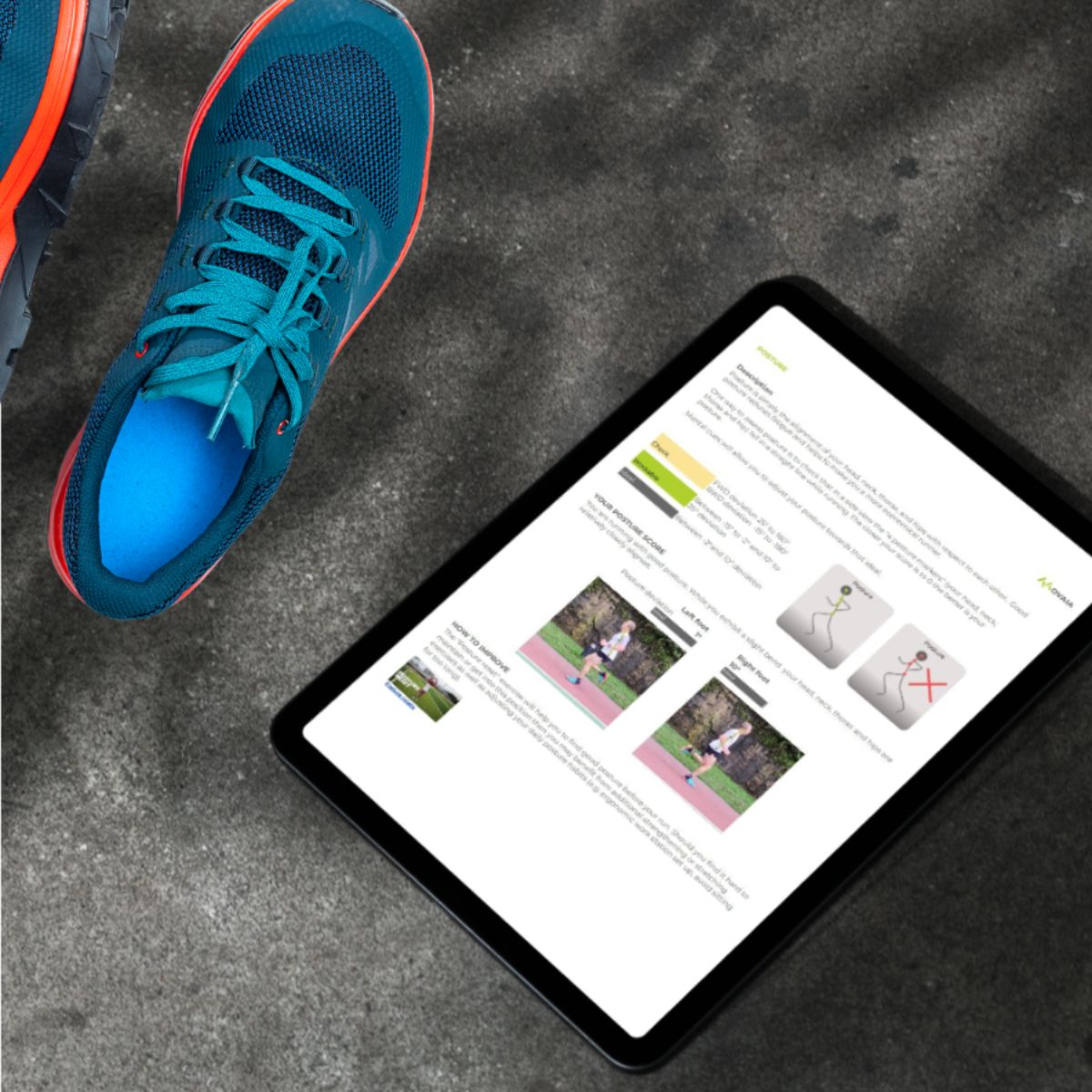
For All Runners, From Novice to Elite: Movaia’s running form analysis is used succesfully by endurance runners of all levels, from beginners to elite athletes. (Don’t take our word for it, check out the reviews below.)
Our structured approach ensures clarity as you progress. Start with foundational “Level 1′ elements and work your way up to advanced ‘Level 3’ metrics. The result? Faster, safer runs with reduced injury risk.
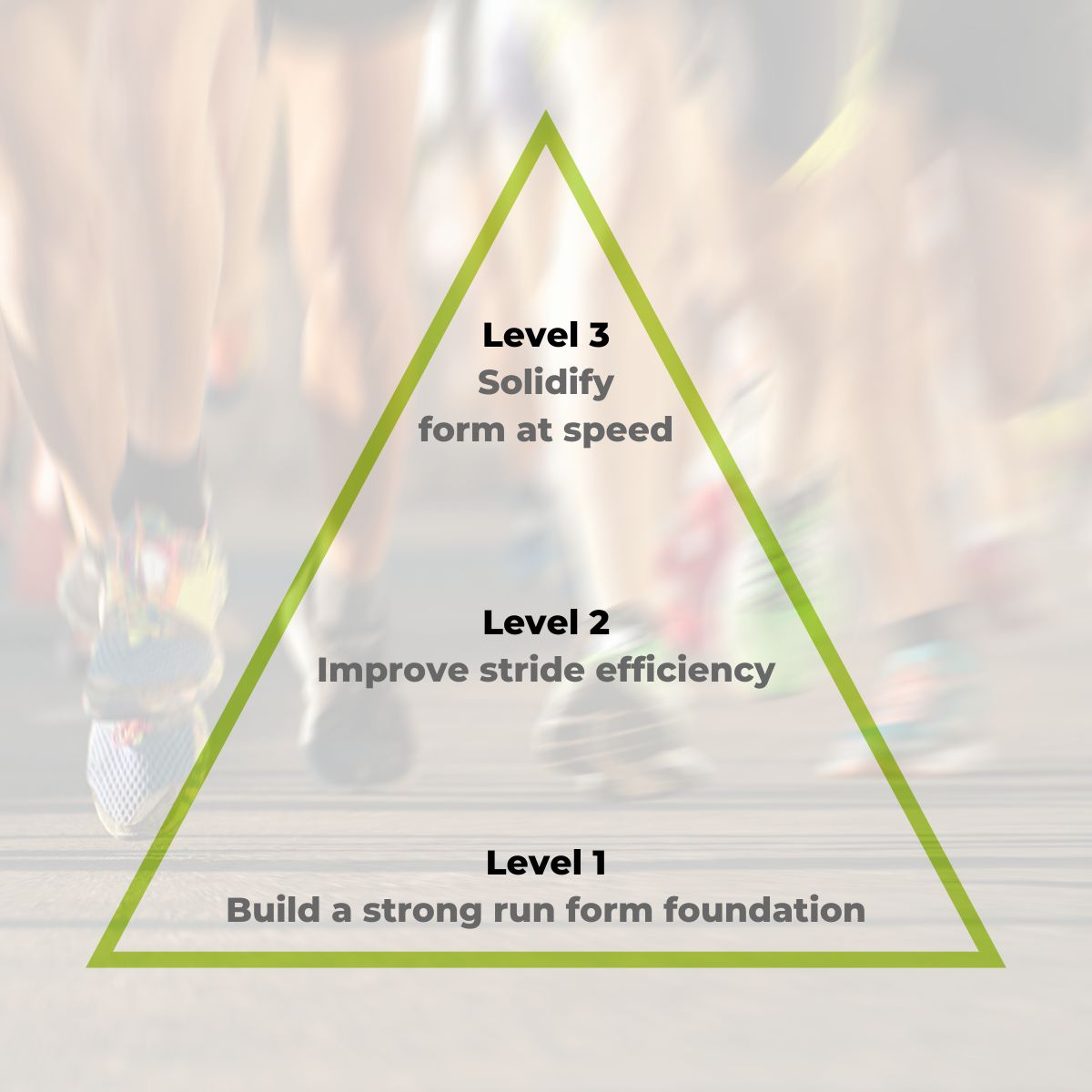
If we see anything sub-optimal in the running form analysis of your video, we give you straightforward drills and videos to help you develop perfect running form.
Feel like a new runner in just weeks, with more stamina and more power in your strides.
Step rate is the number of steps taken during each minute of running. It determines how fast you can run. Step rate also has a big effect on the angle of your foot when it hits the ground (foot angle).
Step rate varies with intensity. Very high step rates tend to be ideal for sprinting, slower step rates are common for ultra-distance running. Typical distance running step rates tend to fall between 170 and 200 steps per minute.
A too-slow step rate can decrease your running velocity and increases the likelihood that you will be a pronounced heel-striker. An overly fast step rate can actually decrease your step length and thus slow you down as well.
Foot Angle is simply the angle the foot makes with the ground at the instant when it first makes ground contact. Your foot angle determines braking force, ground-contact time (duration of stance), running velocity, ground impact forces, and the risk of certain injuries.
The shank angle at touch down (or strike angle) is the angle between your shank and a line drawn perpendicular to the ground at the time of impact. This angle determines how close your foot lands to your center of mass, which influences injury risk and efficiency. It also determines the amount of “sweep”. “Sweep” is the movement from maximum forward extension of the foot to the strike angle at touch down.
Posture is simply the alignment of your head, thorax, and hips with respect to each other. Good posture reduces fatigue and helps to make you a more economical runner.
Lean determines whether propulsive forces will primarily be directed up and forward, straight up, or up and backward. An overly forward lean decreases the amount of critical vertical propulsive force and actually shortens step length.
A too-small or negative lean means that your body is too straight or tilted backward and thus that not enough forward propulsive force is being created.
The angle at which you bend your arms at your elbows impacts your running performance significantly. Arms that are not adequately flexed at the elbows tend to slow cadence, while arms that are properly flexed at the elbows reinforce high cadence.
We also check for excessive arm forward or backward-movement.
Ground contact time measures how long each leg is on the ground, from touch down to toe off. Faster runners typically have lower GCT. GCT decreases with more strength, high leg stiffness and good running form (strong heel strikers tend to have longer GCT).
A significant difference in ground contact time between left and right foot may correlate with decreased running efficiency and increased injury risk.
Vertical Oscillation of the Pelvis measures the amount of up and down movement (‘bounce’) that occurs while you run. Increased up and down movement may indicate increased braking occurring as you run. A reduction in this may indicate a smoother transition through the running cycle and correlates with improve running performance. Increased cadence and forward lean can mitigate excessive vertical oscillation.
Too little vertical oscillation may indicate a lack of power in the stride, resulting in reduced flight time and pace. Work to increase strength and endurance will typically improve too-low vertical oscillation.
Contralateral Pelvic Drop, also known as ‘hip drop’ or ‘Trendelenburg Gait’, is the amount the opposite hip drops when the leg on the ground is in the midstance phase of running. Excessive or limited contralateral hip drop can contribute to injuries, e.g. knee injuries. Limited pelvic drop may indicate excessive protective stabilization by runners experiencing pain. This metric is available if an optional slow motion rear view video of a runner on a treadmill is uploaded.
Step width measure the deviation of each foot print from a line running straight down through the center of your body. How far apart each foot is from each other can affect how forces are distributed in each part of the body.
A too narrow step can increase loading on the outer knee, where it may cause for example IT band pain. Having too wide of a step decreases running efficiency. This metric is available if a slow motion rear view video of a runner on a treadmill is uploaded.
Shoot the video yourself or ask a friend. Not sure how? Here are some easy instructions or watch us record a video here,

Receive your running form analysis with clear feedback. ‘Seeing is believing’ so we make sure to include pictures of your running form at critical phases of the gait cycle and illustrations of good form. This way you can visualize your individual running technique and how to achieve proper running form.
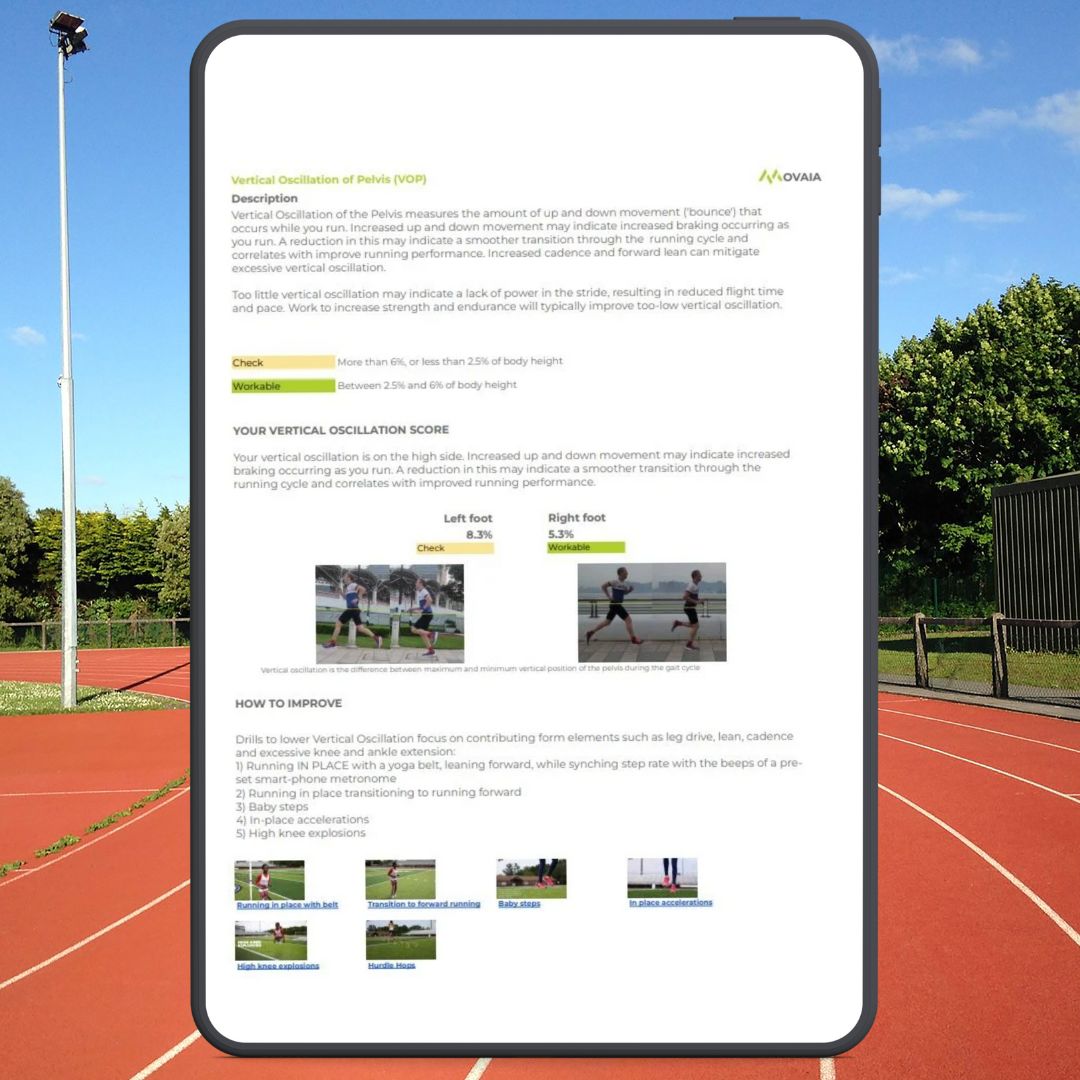
Improve quickly with exercise recommendations, a training plan and exercise videos.
Start now to become faster and
more injury-resistant
Movaia’s Reviews


Are you aiming for a PR?
Are you sick and tired of being constantly injured?
Optimize your running technique and realize your true potential as a runner.